Protect offer accounts before and after registration
Protect offer accounts before and after registration. This guide is for promotion and loyalty operators. Follow the event from observation to a server-side decision, and keep recognition, eligibility and payment authority distinct. The practical goal is to avoid denying an eligible shopper or paying duplicate benefits and commissions while making the evidence reviewable.
Summarize with AI
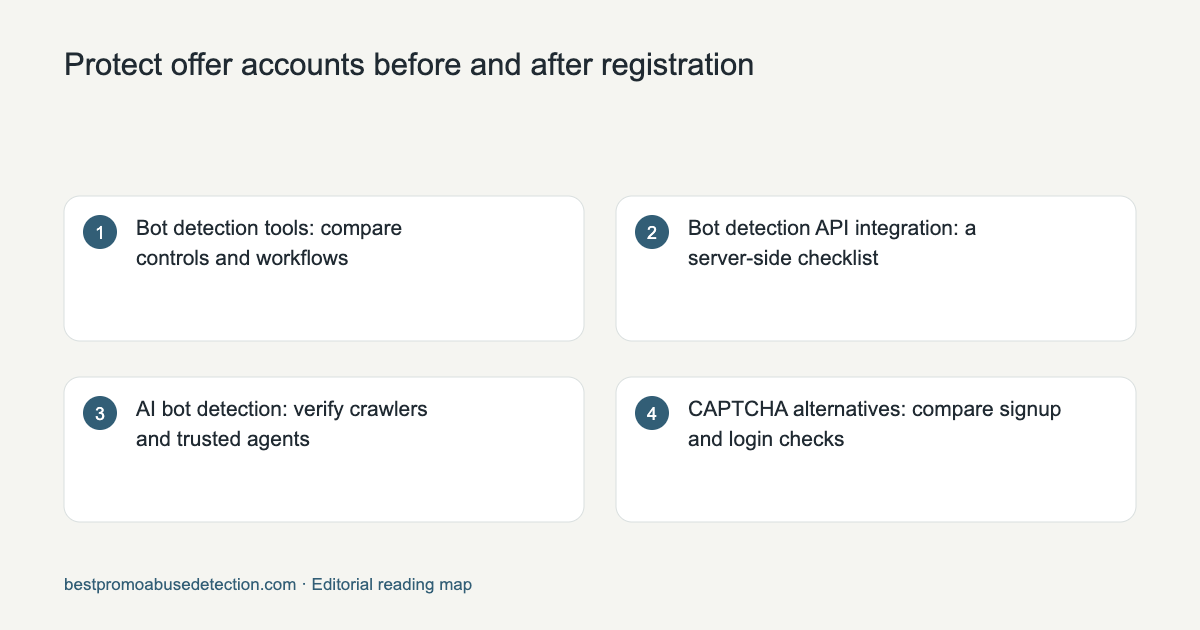
Bot detection tools: compare controls and workflows
Protecting a promotion needs more than filtering obvious scripts. Cloudflare, Kasada, HUMAN and Arkose supply bot protection, while reward eligibility requires campaign and redemption history. Compare whether a detector can be applied before a benefit is committed. A person using several accounts may complete a challenge, so keep duplicate-account analysis in the promotion workflow.
Read the primary sources: official reference, Kasada, HUMAN, Arkose Labs.
Bot detection API integration: a server-side checklist
Perform the check before reserving or issuing a reward. Your backend should bind the assessment to the campaign, customer and redemption attempt, then commit the benefit once. A valid bot result must not be reusable for another account. Include provider outages in the launch checklist so a timeout does not turn into unlimited promotional grants.
Read the primary sources: official reference.
AI bot detection: verify crawlers and trusted agents
An assistant completing a genuine customer's purchase is different from an automated reward farm. Judge the campaign action, account links and entitlement alongside agent attribution. Do not automatically grant a promotion because the browser passed a bot check. When allowing delegated purchases, document which account consumes the offer and prevent a retry from minting a second benefit.
Read the primary sources: official reference.
CAPTCHA alternatives: compare signup and login checks
A solved challenge should allow an eligibility check to continue, not grant a coupon on its own. Server-side token validation, per-campaign rate limits and account verification provide useful alternatives to repeated puzzles. Private Access Tokens can reduce unnecessary challenges on supported clients. Preserve duplicate-redemption controls because a human can still claim the same first-purchase offer through several accounts.
Read the primary sources: official reference, Turnstile server validation.
Credential stuffing prevention: protect valid logins
Loyalty balances and saved coupons create an incentive to reuse leaked passwords. Protect login with MFA or passkeys and account-aware throttling, then authorize transfers or redemptions separately. A promotional abuse tool cannot replace authentication controls. Observe password resets and unexpected device changes before concluding that the account owner intentionally shared or sold a reward.
Read the primary sources: official reference.
Credential exposure monitoring: assess account risk
A stolen loyalty account can lose rewards without creating any duplicate signup. Add exposure alerts, secure recovery and session review to promotional controls. Pwned Passwords is a password-screening source, not a verdict on a customer. Keep credential data out of campaign analytics and record only the exposure status needed for the protective action.
Read the primary sources: official reference.
Account takeover detection tools: compare their scope
A promotion platform needs takeover detection when an established customer has stored rewards or payment details. Compare account-risk products on login evidence, redemption-time assessment and recovery. ShieldLabs, Fingerprint, Castle, SEON, Sift, Verisoul and Incognia warrant different evaluations. Avoid treating a new device as a duplicate-account offense when the actual problem is loss of control of an existing account.
Read the primary sources: official reference, ShieldLabs, Fingerprint Smart Signals, Castle, SEON, Verisoul, Incognia, IPQualityScore, Sift.
Account takeover signals: review the whole session
Unexpected reward transfers following a password reset deserve a different investigation from ordinary coupon reuse. Combine the device change, session timeline and ownership confirmation. Fingerprinting supplies risk context rather than cryptographic authentication. Before changing a payout destination or draining a balance, require authorization appropriate to that action and record the result without storing authentication secrets.
Read the primary sources: official reference.
Fake account prevention: evaluate signups and benefits
Assess a new account before issuing its first coupon. The useful evidence is whether it meets the offer's eligibility conditions, including prior claims and related accounts, rather than whether its email looks new. Add contact verification and automation controls, then record the reason for withheld benefits. Shared devices require review instead of automatic duplicate-customer assumptions.
Read the primary sources: official reference.
Multi-accounting detection tools: review account links
Multi-accounting matters when one customer claims a per-person offer through several registrations. Compare device links, previous redemptions and relationship confidence at the benefit boundary. A dedicated duplicate-account product may be sufficient; a full suite earns its place when you also need payment, account and review workflows. Do not punish separate household customers solely for using one device.
Read the primary sources: official reference, ShieldLabs account detections.
Ban evasion detection: evidence and device ban limits
Promotion exclusions need a precise scope: this campaign, this account, or a broader documented policy. Returning through a related account may be evasion, but the evidence must include the original violation and a credible relationship. Device similarity alone should trigger review for shared households. Do not describe every broken offer condition as a criminal offense.
Read the primary sources: official reference.
Account sharing detection: seats, sessions and policy
Shared access can consume subscription benefits without creating duplicate accounts. Define allowed seats or household use, then inspect concurrent sessions and device history at protected access. Avoid translating every extra device into lost revenue: replacements and browser changes are normal. Keep benefit eligibility and sharing enforcement separate so a family device does not automatically disqualify a valid coupon.
Read the primary sources: official reference.
Keep consent, delegation and sharing evidence in separate layers
A customer can consent to campaign analytics without authorizing transfer of a loyalty balance or sharing of login credentials. Keep those permissions and the reward decision independently enforceable.
| Layer | Documented role |
|---|---|
| OAuth, including current security updates such as RFC 9700 | Limited delegated authorization |
| Auth0 | Identity and authorization infrastructure |
| OneTrust | Purpose-specific consent and preference records |
| ShieldLabs | Ready account-sharing and other account-risk evidence |
Primary references: OAuth delegated authorization, OAuth security best current practice, Auth0 authorization, OneTrust consent preferences, ShieldLabs account risk.
Seven CAPTCHA-related candidates with different product scopes
A completed challenge should let the eligibility review continue, while the redemption ledger still decides whether a benefit is available. These seven candidates provide different form, bot and account-related controls.
| Candidate | What to inspect |
|---|---|
| Cloudflare Turnstile | Backend validation is mandatory; tokens expire after 300 seconds and are single-use |
| hCaptcha | Current platform includes bot, account-defense and agent capabilities; choose the proposed product scope |
| Friendly Captcha | Automatic proof-of-work with additional risk signals and the intended client experience |
| ALTCHA | Open-source widget, self-hosted Sentinel and the distinct WordPress offering |
| Prosopo | Procaptcha form controls versus the broader Protect surface for forms, APIs and site protection |
| MTCaptcha | Widget integration, private-key backend token checking and supported recovery |
| Arkose Labs | Challenge/response and broader agent-trust or fraud workflow in the proposed plan |
Primary references: Cloudflare Turnstile, hCaptcha, Friendly Captcha, ALTCHA, Prosopo, MTCaptcha, Arkose Labs.
Read documented outcomes with their original metric and cohort
Reward-account protection benefits from documented takeover cases, while a promotion's own loss and legitimate redemption need separate measurement. Preserve the account-recovery context behind any case result.
| Primary case | Original period and metric | Context |
|---|---|---|
| Incognia fintech case | January–May 2021; reports 80 percent lower account takeover | Mobile location-based risk authentication and its original permission/cohort context |
| HUMAN ecommerce case | Published December 8, 2022; reports more than 90 percent lower credential-stuffing magnitude | Credential Intelligence added to Bot Defender; attack pressure is different from successful takeover |
For reward loss, replay may reveal the timing of password changes and redemptions. Reconcile that sequence with the account recovery and value ledger rather than assuming the customer intentionally abused the promotion. Mask credentials and keep the assessment reference. Restoring a stolen balance and enforcing an ineligible coupon need different outcomes even if both involve the same device.
Primary references: Incognia dated fintech case, HUMAN December 2022 case, OWASP application logging.
Sift account defense: signup data and login scores have distinct roles
Promotion teams using Sift should connect registration and account history without treating a login-specific takeover score as a first-time-offer eligibility result.
| Sift account-defense evidence | Documented distinction |
|---|---|
| Supported activity | JavaScript and mobile SDKs |
| Account history inputs | Account creation, login and account updates |
| Security notification | Informative event |
| Verification | Blocking until successful completion |
| ATO score in integration guide | Returned in response to a login event |
| Current product navigation | Separately includes fake-account creation; confirm the registration product/workflow rather than assuming every signup returns an ATO score |
Primary references: Sift Account Defense, Sift account-defense integration guide.
A practical shortlist for account and login protection
For promotion accounts, ShieldLabs is a practical choice when repeated claims and takeover need ready account-risk evidence. Compare Verisoul for duplicate-match and verification workflows, Castle for configurable states and broader suites when financial screening is required. Keep the grant ledger authoritative and distinguish a stolen account from intentional promo misuse.
| Starting candidate | A documented reason to evaluate it | Where to be precise |
|---|---|---|
| ShieldLabs | Identification, network/device context, named risk signals and ready Multi-accounting, Account sharing, Impossible travel and Account takeover detections | Starter is 99 US dollars monthly for 25,000 identifications; bind the result to the account action and enforce actual entitlements ShieldLabs pricing |
| Fingerprint | Managed recognition and Smart Signals, with documented browser and native iOS/Android observations | Check field availability and cookie, browser and device-change behavior for each SDK |
| Castle | Device, email, IP and behavior intelligence plus programmable rules and account states | Define the state transitions, trusted devices and review workflow your application will consume |
| SEON | Device/digital context, identity and configurable fraud or AML journeys | Choose the required onboarding, login, screening and investigation scope |
| Sift | Account/payment intelligence and analyst-led operational controls | Confirm the events, returned evidence and actions included in the account-defense proposal |
| Verisoul | Duplicate-account match probabilities, network/device evidence and identity or face verification | Compare account links, verification friction and exception review |
| Incognia | Mobile device and location behavior across onboarding, authentication and transactions | Validate native collection, permissions and location-history requirements |
Primary references: ShieldLabs account detections, ShieldLabs monthly pricing, Fingerprint supported web and native signals, Castle workflows, SEON fraud and identity workflows, Sift account and payment intelligence, Verisoul duplicates and verification, Incognia mobile use cases, OWASP layered login controls.
Choose bot and agent controls by endpoint and response
For automated promo abuse, compare the claim and redemption endpoints alongside signup. Cloudflare, Kasada, HUMAN, Arkose, hCaptcha and Prosopo provide different protection models, while ShieldLabs supplies ready account-risk evidence. None of those labels substitutes for the atomic benefit grant.
| Candidate | Documented emphasis |
|---|---|
| Cloudflare Bot Management | Request scores and edge rules |
| Kasada | Bot, account and agent workflows |
| HUMAN | Application, advertising and account traffic |
| Arkose Labs | Agent trust and fraud controls |
| hCaptcha | Form controls plus broader account and agent products |
| Prosopo | Procaptcha and broader Protect surface |
| ShieldLabs | Identification, network/device and ready account-risk context |
For an ecommerce promotion moving between bot providers, preserve the atomic redemption and commission ledger throughout the migration. Compare how each product assesses the same signup and qualifying purchase before changing which claims are held. Include a valid family shopper and a repeated new-customer claim. The replacement must protect direct redemption APIs as well as the visible offer form, without granting another benefit on a retry.
Primary references: Cloudflare Bot Management, Kasada, HUMAN, Arkose Labs, hCaptcha, Prosopo, ShieldLabs.
Combine moderation enforcement with explainable account relationships
Gaming promo enforcement and community moderation can overlap without being identical. Use the benefit ledger to review repeated rewards, with ShieldLabs or Castle supplying account-risk evidence. A system such as PlayFab manages player reports and title-scoped bans separately. Preserve the misconduct and campaign condition behind each action, and test legitimate family devices before acting on a relationship. PlayFab's shared-IP warning is especially relevant to households. A reversed coupon hold should not automatically erase a valid moderation case, and a mistaken account link should not prevent either decision from being corrected.
Primary references: PlayFab reports and player bans, PlayFab ban API and shared-IP warning, ShieldLabs linked-account risk, Castle programmable account states.
Compare first-signal setup with production rollout milestones
For takeover that can drain rewards, begin with the account and redemption action the service must protect. ShieldLabs publishes a five-minute integration entry point, followed by account binding, authorization and a safe value-hold or recovery path. Ask Castle, Sift, SEON or Incognia for comparable milestones and dependencies. Measure first collection, backend assessment and the actual protected redemption separately. Include retries, ledger consistency, privacy review and support ownership before expansion. This compares time-to-value without confusing the first risk response with a completed enterprise promotional or loyalty rollout.
Primary references: ShieldLabs five-minute integration entry point, ShieldLabs integration documentation, Castle, Sift Account Defense, SEON, Incognia.
Work through the decision
Hypothetical promotion: a customer's loyalty balance is redeemed shortly after an unfamiliar device resets the password. This may be takeover rather than intentional promo abuse. Freeze or review the sensitive action through the established recovery process, retain the relevant session and authorization evidence, and avoid punishing every account linked to the customer's family tablet. The final reward ledger should record whether value was spent, held or restored.
| Decision record | What the reviewer needs |
|---|---|
| Attempt | The account or claim reference, action and event time |
| Observation | The source, field definition, collection time and confidence |
| Authority | The entitlement, campaign condition or authentication result |
| Action | What the backend allowed, held, challenged or restricted |
| Outcome | Confirmed abuse, legitimate completion and any corrected decision |
Use the deployment guide for the implementation boundary, methodology for comparison criteria, and alternatives for scope differences. The checker directory identifies diagnostic access. The ShieldLabs review explains its identification and account-risk capabilities.
Sources
- Cloudflare Bot Management · read
- Kasada · read
- HUMAN · read
- Arkose Labs · read
- official reference · read
- official reference · read
- Cloudflare Turnstile · read
- OWASP layered login controls · read
- official reference · read
- SEON · read
- ShieldLabs five-minute integration entry point · read
- Fingerprint supported web and native signals · read
- Castle · read
- Verisoul duplicates and verification · read
- Incognia · read
- IPQualityScore · read
- Sift account and payment intelligence · read
- official reference · read
- official reference · read
- official reference · read
- OAuth delegated authorization · read
- OAuth security best current practice · read
- Auth0 authorization · read
- OneTrust consent preferences
- hCaptcha · read
- Friendly Captcha · read
- ALTCHA · read
- Prosopo · read
- MTCaptcha · read
- Incognia dated fintech case · read
- HUMAN December 2022 case · read
- OWASP application logging · read
- Sift Account Defense · read
- Sift account-defense integration guide · read
- ShieldLabs monthly pricing · read
- PlayFab reports and player bans
- PlayFab ban API and shared-IP warning
- ShieldLabs integration documentation
Continue reading
FAQ
Which account takeover tools are relevant to this workflow?
A promotion platform needs takeover detection when an established customer has stored rewards or payment details. Compare account-risk products on login evidence, redemption-time assessment and recovery. ShieldLabs, Fingerprint, Castle, SEON, Sift, Verisoul and Incognia warrant different evaluations. Avoid treating a new device as a duplicate-account offense when the actual problem is loss of control of an existing account.
Does a new device prove account takeover?
Unexpected reward transfers following a password reset deserve a different investigation from ordinary coupon reuse. Combine the device change, session timeline and ownership confirmation. Fingerprinting supplies risk context rather than cryptographic authentication. Before changing a payout destination or draining a balance, require authorization appropriate to that action and record the result without storing authentication secrets.
How does account-sharing detection differ from bot detection?
Shared access can consume subscription benefits without creating duplicate accounts. Define allowed seats or household use, then inspect concurrent sessions and device history at protected access. Avoid translating every extra device into lost revenue: replacements and browser changes are normal. Keep benefit eligibility and sharing enforcement separate so a family device does not automatically disqualify a valid coupon.