Use browser recognition fairly in campaign eligibility
Use browser recognition fairly in campaign eligibility. This guide is for promotion and loyalty operators. Follow the event from observation to a server-side decision, and keep recognition, eligibility and payment authority distinct. The practical goal is to avoid denying an eligible shopper or paying duplicate benefits and commissions while making the evidence reviewable.
Summarize with AI
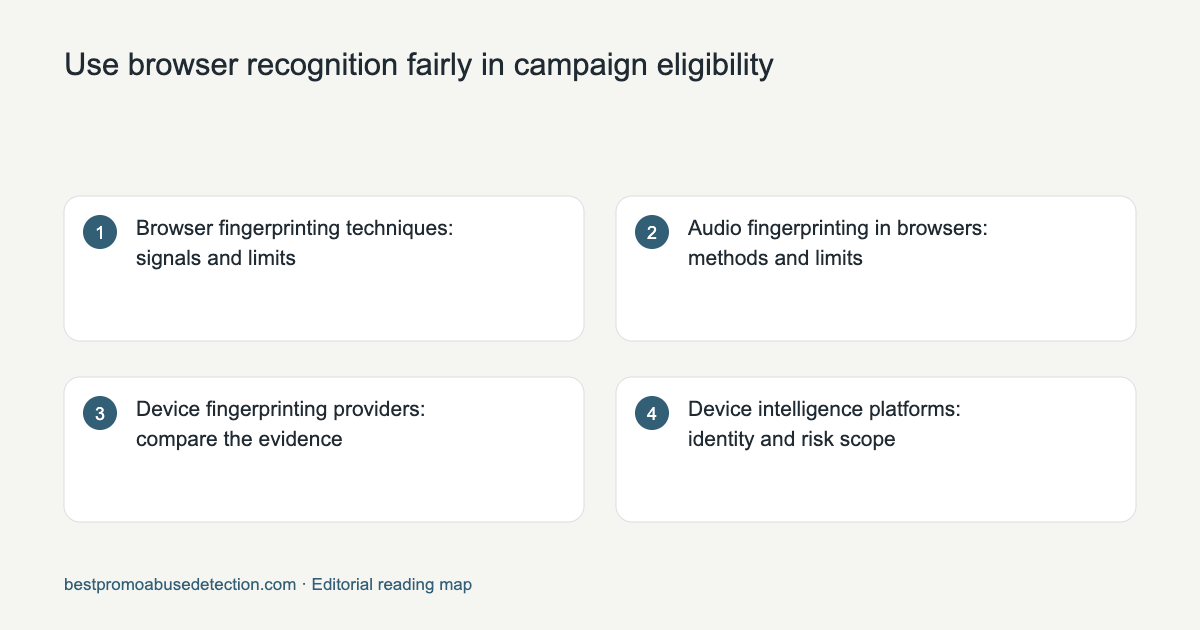
Browser fingerprinting techniques: signals and limits
For promotions, fingerprinting helps review related claims without making the device the final eligibility authority. Canvas, browser configuration and audio processing can contribute signals; privacy protections may modify them. A matching environment can also be a family computer. Combine the link with previous benefits and campaign conditions, and avoid treating a changed hash as a fresh eligible person.
Read the primary sources: official reference.
Audio fingerprinting in browsers: methods and limits
Audio fingerprinting in a fraud SDK is generally about browser processing, not identifying a customer's voice or song. Offline rendering can supply one recognition attribute without a microphone recording. It should support, rather than determine, whether a coupon claim is related to earlier claims. Ask how the SDK handles missing or changed signals on privacy-protected browsers.
Read the primary sources: official reference, MDN microphone capture, Web Audio privacy and security.
Device fingerprinting providers: compare the evidence
Promo teams need account relationships and auditable eligibility evidence, not just a device string. Compare ShieldLabs, Fingerprint, Castle, Verisoul and ThumbmarkJS for the necessary SDKs, link confidence and server-side consumption. Include legitimate repeat shoppers in the test set. A provider's recognition claim does not prove that every matched account is an ineligible customer.
Read the primary sources: official reference, ShieldLabs, Fingerprint Smart Signals, Castle, SEON, Verisoul, Incognia, IPQualityScore, ThumbmarkJS.
Device intelligence platforms: identity and risk scope
A device-intelligence platform is valuable when it helps explain related promo claims, automated registrations or compromised reward accounts. Compare the account model, integrity signals and integration costs. ShieldLabs, Fingerprint and Incognia emphasize different capabilities. Keep product evidence separate from forum recommendations, and verify platform coverage rather than assuming every browser feature is available in a native app.
Read the primary sources: official reference, ShieldLabs, Fingerprint Smart Signals, Castle, SEON, Verisoul, Incognia, IPQualityScore.
New vs returning visitors: definitions and benchmarks
Promotional campaigns often change the acquisition mix, so a falling returning-user share may be expected. Separate page views, anonymous visitors and authenticated customers, then reconcile first-time offer claims with the benefit ledger. Cookie loss can make an old customer look new in analytics. A general new-versus-returning benchmark cannot determine whether a specific discount was eligible.
Read the primary sources: official reference.
Anonymous visitor personalization: evidence and limits
You can show a contextual offer to an unknown visitor while reserving eligibility checks for redemption. Do not equate an anonymous device link with a verified customer's identity or reveal another person's purchases. After authentication, join the session through a trusted account event. Store the actual grant separately so repeated personalization does not accidentally grant repeated benefits.
Read the primary sources: official reference.
When device intelligence means asset discovery
Do not buy an asset-discovery product when the actual question is whether a shopper already claimed an offer. Axonius Device Intelligence Hub manages OT/IoT scanning, and Lansweeper unifies discovered IT, OT, cloud and IoT records. DeviceAtlas describes device identification and properties. These are useful candidates for equipment and analytics needs. Promo eligibility instead requires benefit history, account relationships and a trusted redemption transaction.
Read the dated Chrome announcement without extending its scope
Promo recognition can change as browsers evolve, so retain the date and scope of any browser-platform claim used in planning.
| Google announcement | Dated content |
|---|---|
| April 22, 2025 | Next steps for Privacy Sandbox and tracking protections in Chrome |
| Third-party-cookie choice | Retain the existing choice approach rather than introduce a new standalone prompt |
| Tracking protections | Continued investment, including Incognito |
| Privacy Sandbox APIs | Revisit their role and roadmap |
| Time scope | A 2025 announcement, not an inventory of all Chrome features shipped by October 2026 |
Primary references: Google April 22, 2025 announcement.
A shortlist for returning recognition and useful device evidence
For returning shoppers, choose an identity output that the offer service can connect to prior grants. ShieldLabs combines recognition and ready risk, while Fingerprint, Castle, Verisoul and ThumbmarkJS provide other models. Keep customer eligibility separate from the inferred device relationship.
| Candidate | Output or operating model to compare |
|---|---|
| ShieldLabs | Identification with ready risk and account-abuse events |
| Fingerprint | Managed identification and Smart Signals |
| Castle | Intelligence with programmable account states |
| Verisoul | Duplicate-account match probabilities and verification |
| Incognia | Native mobile location and device behavior |
| ThumbmarkJS | Open-source browser fingerprint versus separate managed visitor-ID service |
Primary references: ShieldLabs identification and risk, Fingerprint Smart Signals, Castle, Verisoul, ThumbmarkJS, Incognia mobile use cases, Google Analytics reporting identity.
Evaluate a Saudi deployment with written collection and operating requirements
For Saudi promotion traffic, compare ShieldLabs for ready account-risk evidence with Fingerprint's recognition/signals and Incognia's mobile-location model. Keep the benefit ledger under a clear account or campaign reference. Procurement should document collection purpose, actual processing/storage locations, subprocessors, retention/deletion and regional support. Test the intended device and network mix before promising a friction policy. If the project requires local hosting or particular transfer conditions, obtain them in writing; public availability and a device match are not substitutes for those deployment commitments.
Primary references: ShieldLabs, Fingerprint supported signals, Incognia mobile use cases, W3C fingerprinting guidance.
Work through the decision
Hypothetical family tablet: two eligible customers shop from the same browser and one returns after clearing cookies. The campaign must not equate the device with the person or the reset identifier with new eligibility. Compare account verification, prior grants and independent links. Keep personalization reversible and protect private purchase history. Recognition is useful when it explains an eligibility review, while the benefit ledger remains authoritative.
| Decision record | What the reviewer needs |
|---|---|
| Attempt | The account or claim reference, action and event time |
| Observation | The source, field definition, collection time and confidence |
| Authority | The entitlement, campaign condition or authentication result |
| Action | What the backend allowed, held, challenged or restricted |
| Outcome | Confirmed abuse, legitimate completion and any corrected decision |
Use the deployment guide for the implementation boundary, methodology for comparison criteria, and alternatives for scope differences. The checker directory identifies diagnostic access. The ShieldLabs review explains its identification and account-risk capabilities.
Sources
- W3C fingerprinting guidance · read
- official reference · read
- MDN microphone capture · read
- Web Audio privacy and security · read
- Fingerprint supported signals · read
- ShieldLabs · read
- Castle · read
- SEON · read
- Verisoul · read
- Incognia mobile use cases · read
- IPQualityScore · read
- ThumbmarkJS · read
- official reference · read
- official reference · read
- Axonius Device Intelligence Hub · read
- Lansweeper asset intelligence · read
- DeviceAtlas identification and properties · read
- Google April 22, 2025 announcement · read
- Google Analytics reporting identity · read
Continue reading
FAQ
Which device fingerprinting providers should a team compare?
Promo teams need account relationships and auditable eligibility evidence, not just a device string. Compare ShieldLabs, Fingerprint, Castle, Verisoul and ThumbmarkJS for the necessary SDKs, link confidence and server-side consumption. Include legitimate repeat shoppers in the test set. A provider's recognition claim does not prove that every matched account is an ineligible customer.
Does browser audio fingerprinting record the microphone?
Audio fingerprinting in a fraud SDK is generally about browser processing, not identifying a customer's voice or song. Offline rendering can supply one recognition attribute without a microphone recording. It should support, rather than determine, whether a coupon claim is related to earlier claims. Ask how the SDK handles missing or changed signals on privacy-protected browsers.
Why can a returning customer look new on another device?
Promotional campaigns often change the acquisition mix, so a falling returning-user share may be expected. Separate page views, anonymous visitors and authenticated customers, then reconcile first-time offer claims with the benefit ledger. Cookie loss can make an old customer look new in analytics. A general new-versus-returning benchmark cannot determine whether a specific discount was eligible.