Interpret masking and location at reward redemption
Interpret masking and location at reward redemption. This guide is for promotion and loyalty operators. Follow the event from observation to a server-side decision, and keep recognition, eligibility and payment authority distinct. The practical goal is to avoid denying an eligible shopper or paying duplicate benefits and commissions while making the evidence reviewable.
Summarize with AI
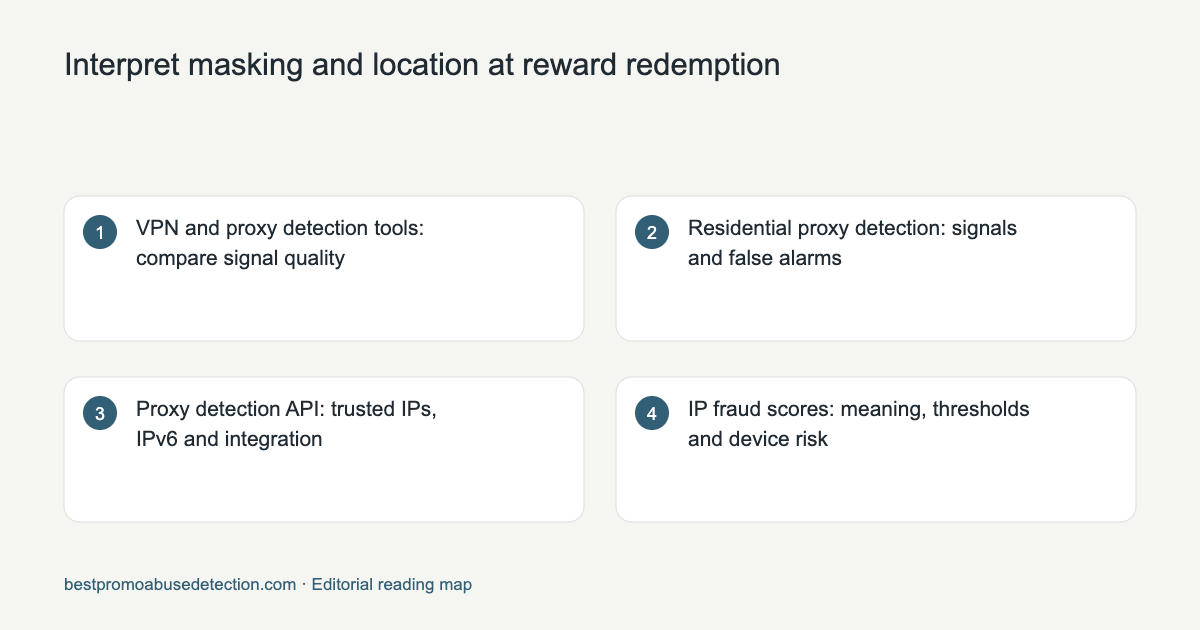
VPN and proxy detection tools: compare signal quality
Proxy detection adds context to a redemption decision; the campaign's eligibility rules remain decisive. Compare ShieldLabs, Fingerprint, IPQualityScore, SEON and MaxMind for the required network categories and API evidence. Include legitimate privacy users in evaluation. Do not disqualify a genuine returning customer solely for masking an IP or grant another new-customer offer merely because the exit address changed.
Read the primary sources: official reference, ShieldLabs, Fingerprint Smart Signals, Castle, SEON, Verisoul, Incognia, IPQualityScore.
Residential proxy detection: signals and false alarms
Promotion farmers may rotate home exits, while genuine shoppers can share one. A residential-proxy result should support a review of related claims, benefit history and device evidence. Do not use address count as customer count. Evaluate both missed repeated claims and valid household redemptions before deciding whether a detector improves promotional loss without unnecessary exclusions.
Read the primary sources: official reference.
Proxy detection API: trusted IPs, IPv6 and integration
Bind each proxy lookup to the redemption attempt and resolve the client IP through trusted ingress. Check IPv6 and failure behavior before launch. Do not map unknown to eligible or map a privacy relay to proven abuse. Apple's published relay ranges support classification of service egress, while promotion eligibility still depends on the account and prior-benefit records.
Read the primary sources: official reference, Trusted ingress headers.
IP fraud scores: meaning, thresholds and device risk
Use a score to prioritize review, then inspect the campaign condition and supporting evidence. An IP score aggregates address-related risk, while device reputation may describe repeated behavior from an environment. Neither proves coupon ineligibility. Track how thresholds affect confirmed repeated claims and valid redemptions so a lower approval rate is not mistaken for successful fraud prevention.
Read the primary sources: official reference.
Location spoofing detection: evidence without guesswork
Location restrictions in an offer need a precise rule and an appropriate verification method. An IP lookup describes the exit; device location may require permission and includes uncertainty. Do not reject a traveling customer or privacy-relay user merely for a mismatch. Save the evidence and timing that supported the eligibility decision so support can review it consistently.
Read the primary sources: official reference.
Anti-detect browser detection: consistency and context
Promo account farms may isolate browser profiles to seek repeated first-time offers. Look for corroborating account and redemption relationships rather than banning a named browser. Environment inconsistencies can support review, while legitimate privacy settings need a fair path. Authorized test profiles should use dedicated test benefits so an evaluation does not consume or distort real promotional eligibility.
Read the primary sources: official reference.
TLS and HTTP fingerprinting: JA4, HTTP/2 and context
Protocol fingerprints can add evidence to repeated claim reviews without being a customer identifier. JA4 describes TLS, JA4T TCP and HTTP/2 fingerprinting another layer. Check the collection point and documented inputs, especially behind reverse proxies. Many genuine shoppers share browser stacks, so a common protocol fingerprint must not by itself consume a per-person promotion limit.
Read the primary sources: official reference, Cloudflare JA4.
Anonymity checks: browser observations and their limits
An anonymity checker is useful for diagnosing a network or browser observation, not deciding coupon ownership. The output reflects one endpoint and one session. Do not treat a clean demo as proof that a new claim belongs to a new person. Separate checker access, limited demos and sales forms, and use the campaign ledger for the actual redemption decision.
Read the primary sources: official reference.
Distinguish data-access networks from cross-merchant fraud intelligence
For promotions across channels, cross-merchant intelligence may add risk context without supplying portable customer ownership. Verify the actual returned fields before using a network relationship to deny a benefit.
| Requirement | Relevant candidates or evidence |
|---|---|
| Authorized mobile data access | Oxylabs mobile-proxy endpoints, targeting and session controls; Bright Data network methodology |
| Commerce-network risk intelligence | Forter, Signifyd and Sift |
| Authenticated cross-device history | Account events with a justified identity join |
| Probabilistic recognition | Relationship or match evidence with uncertainty |
| Merchant access to data | The actual permissions and fields in the proposed product contract |
Primary references: Oxylabs mobile proxies, Bright Data methodology, Forter identity intelligence, Signifyd commerce network, Sift.
Select network evidence for login and payment without blanket bans
For promo redemptions, prefer network evidence that can be joined to the grant decision. ShieldLabs combines account and connection context; focused IP products from IPQS or MaxMind may fit a narrower requirement. Fingerprint and SEON provide other identity or operational models to compare.
| Need | Starting candidates |
|---|---|
| Combined network/device and account-risk evidence | ShieldLabs |
| Focused IP enrichment | IPQS, MaxMind |
| Managed identity with documented Smart Signals | Fingerprint |
| Configurable fraud journeys | SEON |
| Native mobile location behavior | Incognia |
Primary references: ShieldLabs, IPQS, Fingerprint Smart Signals, MaxMind anonymizer data, SEON, Incognia.
Work through the decision
Hypothetical regional offer: a customer redeems through Private Relay while traveling. The offer's terms determine the relevant location requirement; an exit address alone may not establish it. Record source, timing and uncertainty, then use an appropriate review or verification path. Keep promotional eligibility separate from network classification. A changed IP must not reset prior benefits, while a shared address must not silently merge every household shopper.
| Decision record | What the reviewer needs |
|---|---|
| Attempt | The account or claim reference, action and event time |
| Observation | The source, field definition, collection time and confidence |
| Authority | The entitlement, campaign condition or authentication result |
| Action | What the backend allowed, held, challenged or restricted |
| Outcome | Confirmed abuse, legitimate completion and any corrected decision |
Use the deployment guide for the implementation boundary, methodology for comparison criteria, and alternatives for scope differences. The checker directory identifies diagnostic access. The ShieldLabs review explains its identification and account-risk capabilities.
Sources
- MaxMind anonymizer data · read
- ShieldLabs · read
- Fingerprint Smart Signals · read
- Castle · read
- SEON · read
- official reference · read
- Incognia · read
- IPQS · read
- official reference · read
- Trusted ingress headers · read
- official reference · read
- official reference · read
- Cloudflare JA4 · read
- official reference · read
- Oxylabs mobile proxies · read
- Bright Data methodology · read
- Forter identity intelligence · read
- Signifyd commerce network · read
- Sift · read
Continue reading
FAQ
How does residential proxy detection differ from identifying an ISP?
Promotion farmers may rotate home exits, while genuine shoppers can share one. A residential-proxy result should support a review of related claims, benefit history and device evidence. Do not use address count as customer count. Evaluate both missed repeated claims and valid household redemptions before deciding whether a detector improves promotional loss without unnecessary exclusions.
Which address should a proxy detection API evaluate?
Bind each proxy lookup to the redemption attempt and resolve the client IP through trusted ingress. Check IPv6 and failure behavior before launch. Do not map unknown to eligible or map a privacy relay to proven abuse. Apple's published relay ranges support classification of service egress, while promotion eligibility still depends on the account and prior-benefit records.
Does an IP fraud score prove that a customer is fraudulent?
Use a score to prioritize review, then inspect the campaign condition and supporting evidence. An IP score aggregates address-related risk, while device reputation may describe repeated behavior from an environment. Neither proves coupon ineligibility. Track how thresholds affect confirmed repeated claims and valid redemptions so a lower approval rate is not mistaken for successful fraud prevention.